
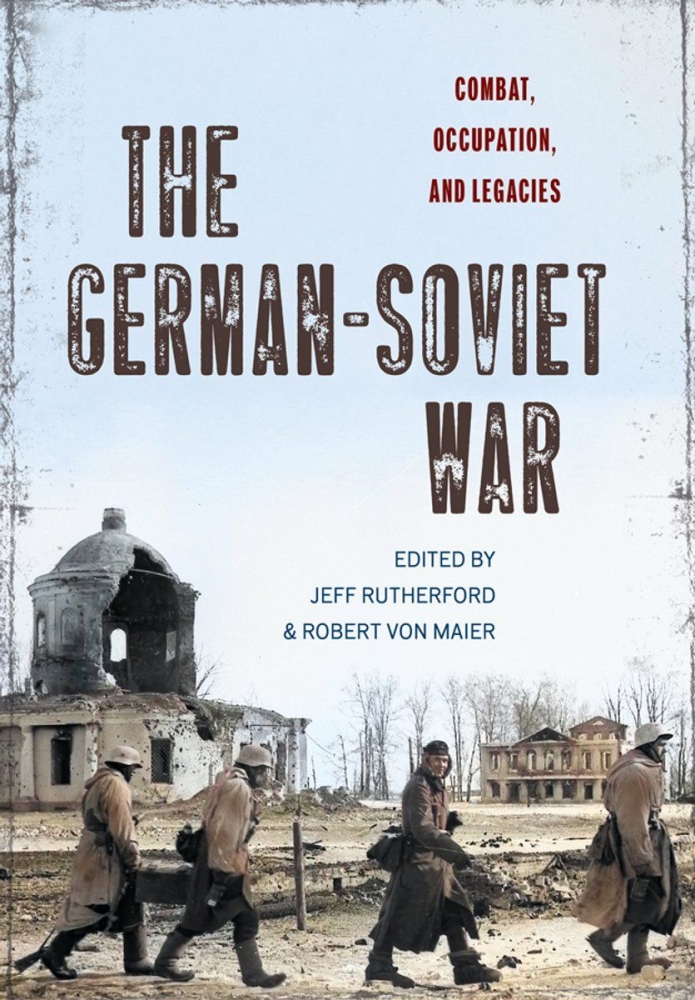
| Title: | The German-Soviet War - Combat, Occupation, and Legacies |
| Writer: | Rutherford, Jeff (ed.) & Maier, Robert von (ed.) |
| Published: | Cornell University Press |
| Published in: | 2025 |
| Pages: | 600 |
| ISBN: | 9781501781070 |
| Review: | The struggle between Nazi Germany and the Soviet Union, which erupted with the German invasion on 22 June 1941 (Operation Barbarossa) and ended almost four years later with the Russian capture of Berlin, is unparalleled among all other wars. Millions of soldiers fought in a hard and brutal conflict that was also a clash of two totalitarian ideologies. Eighty years later, this apocalyptic titanic struggle on the Eastern Front still resonates in various ways in the relationship between Russia and European countries. Historiography, too, will remain fascinated by the conflict between Hitler and Stalin for many years to come. For historians, one can only hope that the Russian archives will one day become fully accessible, allowing greater attention to the Soviet-Russian perspective. In the first decades after 1945, military historiography in particular was viewed rather one-sidedly from the German standpoint. This had much to do with the fact that quite a number of Wehrmacht generals published their memoirs, which found a large readership not only in West Germany but also in other Western European countries and especially in the United States. Among others, David Stahel has pointed out that this influential body of memoir literature was problematic in several respects. Former German commanders all too readily shifted responsibility for Operation Barbarossa, for numerous crimes, and for the eventual defeat onto Adolf Hitler. They cultivated the idea of a brilliant German General Staff which — entirely in the Prussian military tradition — consisted of highly qualified, apolitical professionals who had nothing to do with the war crimes of Hitler, Himmler, and the SS. For a long time, these former top officers got away with this apologetic narrative. From the second half of the 1990s onward, this false narrative was exposed thanks to new research. Among others, Omer Bartov and Felix Römer demonstrated the structural involvement of the Wehrmacht in war crimes (including the notorious "Commissar Order"). The travelling exhibition on the Wehrmacht, shown in various German cities in the late 1990s, also addressed this, initially provoking fierce protests from veterans. The anthology ‘The German-Soviet War’ clearly shows how broad the substantive scope of historical research has now become. The contributions focus not only on aspects of military campaigns, tactics, and technology, but also on the brutal exploitation of the occupied Soviet territories, as well as the systematic extermination of Jews that began in parallel with the German advance. The volume also devotes specific attention to various occupied and allied countries that were drawn into the ruthless war between Nazi Germany and the Soviet Union. Dallas Michelbacher, for instance, contributes a chapter on the treatment of Russian prisoners of war in Romania, a German ally, while Nina Jansz examines the experiences of men from German-annexed Luxembourg who were conscripted into the Wehrmacht. Although this anthology contains many examples of the horrors of this cruel war, the contributions on Romanians, Luxembourgers, Poles, and Ukrainians add interesting depth and nuance to certain aspects. Keith Hann, for example, analyzes the extent to which the Polish People's Army had a Polish-national character. This army was created by the Soviet Union not only to fight the Nazis but also to cut off the Polish anti-communist resistance. Hann reconstructs the development of this army — which eventually numbered some 300,000 Polish soldiers but was led mostly by Russian officers — that achieved military successes against the Wehrmacht, adopted various Polish-nationalist symbols, yet was nevertheless seen (and still is, since the fall of communism in 1989) as a Soviet puppet. Further nuance is provided by David Stahel, the Australian military historian who has built an impressive body of work on the fighting on the Eastern Front (specifically within Army Group Centre’s sphere). In his 2019 book ‘Retreat from Moscow’, he argued that the German withdrawal from Moscow in December 1941 and January 1942 should not so much be regarded as a defeat but, to a large extent, as a strategic success. In this article, he focuses on the actual implementation of Hitler’s “Halt Order” of 26 December 1941, in which the Führer forbade any withdrawal without his explicit permission. Stahel shows that this Halt Order was in reality ignored by many military commanders, with the knowledge and unofficial approval of Field Marshal von Kluge, the commander-in-chief of Army Group Centre. Stahel argues that command practices at the front were far less rigid and obedient than was assumed in Hitler’s distant headquarters (and by many post-war historians). That a total German collapse on the Eastern Front at the end of 1941 was avoided was due not so much to Hitler’s supposed genius but rather to the initiative of commanders who partially ignored his orders—just as they had learned under the old Prussian principle of Auftragstaktik, which encouraged independent decision-making by officers. This excellent anthology offers a richly varied set of insightful essays by renowned authors and is therefore, in fact, indispensable for those with an interest in the history of the Second World War. |
| Rating: |  Excellent Excellent |
Information
- Article by:
- Jan-Jaap van den Berg
- Published on:
- 22-11-2025
- Feedback?
- Send it!
Images

Looking for reliable information or news facts about WW2? Do you want to create your own battlefield tour to sights of wars from the past? Or are you interested in war medals and their recipients? TracesOfWar.com tells you more!
More information

© STIWOT, 1999-2025. All rights reserved. Privacy statement, cookies, disclaimer and copyright