
| Title: | A people destroyed - New research on the Roma genocide 1941-1945 |
| Writer: | Weiss-Wendt, Anton, editor e.a. |
| Published: | University of Nebraska Press |
| Published in: | 2025 |
| Pages: | 332 |
| ISBN: | 9781496234537 |
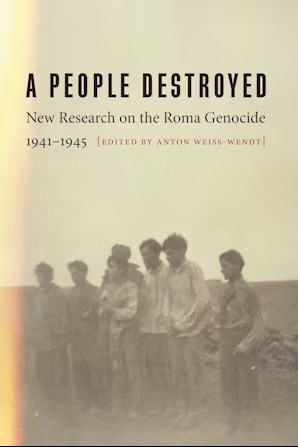
| Description: | The genocide of the Roma, sometimes also referred to as ‘the Porrajmos' (literally, 'the devouring'), is an underrepresented topic in the history of the Second World War. There are several reasons for this. The term Roma describes a very diverse group with different identities. In the Netherlands and Germany, for example, the Roma are mainly the Sinti ethnic subgroup, while in other countries other subgroups are more prominent. Different names are therefore used in different countries. In addition, Roma have been a stigmatised group in Europe for centuries. This did not begin with the Nazis and did not end immediately after the war. Finally, after the war, hardly any institutions were established to deal with the fate of Roma during the war, in contrast to the many institutions that investigate and commemorate the genocide of the Jews. As a result, relatively few studies on the subject have been published. In 2025, however, the volume, A people destroyed: New research on the Roma genocide 1941-1945, edited by historian Anton Weiss-Wendt, was published. Weiss-Wendt is a research professor at the Norwegian Centre for Holocaust and Minority Studies in Oslo. He obtained his PhD in Modern Jewish History at Brandeis University in the United States. He has written (or edited) 12 books, including Nazi Genocide Of The Roma: Reassessment and Commemoration. In addition to the introduction, Weiss-Wendt himself contributes articles on the Roma in Estonia and on the number of Roma murdered. As is usual with an academic volume, the reader is expected to have prior knowledge of the genocide of the Roma and does not provide a chronological overview. Instead, it offers 12 studies that give the reader in-depth insights into current developments in the field. The contributions to the volume come from various areas of expertise, including literature, political science, contemporary history, Jewish history, military history and philosophy. The contributors also come from different countries, ensuring that many perspectives are covered. For example, Patricia Pientka is not only a historian but also a German Sintezza, which gives her contribution an extra dimension. Due to the length of this review, for this discussion, 9 articles were selected to give a representative impression of the entire book. A note on terminology: with Roma being a diverse group and different terminology being used in different countries, contributors also use different variations. Some contributors specifically refer to “Sinti and Roma”; others use “Roma” or the names for specific sub-groups. Sometimes older words like gypsies or ‘Zigeuner’ are also mentioned since distinctions made today were not made during the war. These older words are considered problematic since the groups were labeled from the outside and did not necessarily identify themselves like this. Since this review is written for a wider audience, the term “Roma” is used here for practical reasons to include all sub-groups that might be covered by the umbrella term of “Roma.” In the introduction, Weiss-Wendt describes the state of research into the genocide of the Roma. He comes to the painful conclusion that the situation is particularly worrying in quantitative terms. He also mentions the stigmatisation after the war and the resulting distrust among the Roma as an important reason why opportunities to collect testimonies were insufficiently used between roughly 1945 and 1990. The NIOD (Netherlands Institute for War Documentation) in Amsterdam and the Wiener Library in London are mentioned here as institutions that did record some Roma testimonies among their studies. In his article on the Roma of Flensburg, German historian Sebastian Lotto-Kusche impressively summarises many of the issues faced by Roma in Western Europe. He describes the deportation of dozens of Roma in May 1940 to labour camps in Belzec in the General Government. These labour camps should not be confused with the extermination camp in the same place that was in use in 1942. These families had already been housed in barracks in Flensburg in previous years. It was Nazi policy, originating from the Reich Security Main Office (RSHA), that Roma were not allowed to lead a nomadic existence. The reasons given for this were security considerations and suspicions of espionage. The Flensburg Roma arrived in Belzec via a transit camp in Hamburg as part of a group of about 1,000 Roma. In the autumn of 1940, the labour camps in Belzec closed. In the meantime, a large number of Roma had died there under harsh conditions. Those who survived the labour camps in Belzec were then transported to a labour camp in Krychów. When this labour camp was also shut down, a few Roma managed to spend some time outside of captivity. However, they were forbidden from entering the Reich and, coming from the labour camps, they obviously did not have the opportunity to build a normal life during this period. Nevertheless, a few managed to survive this too. On 16 December 1942, Heinrich Himmler issued the so-called 'Auschwitz Decree'. This decree stipulated that all Roma in areas under Nazi rule had to be deported to Auschwitz, where they ended up in the 'Gypsy camp', a section of Birkenau where Roma families were placed together. On 15 May 1944, camp commander Rudolf Höss ordered that the 'Gypsy camp' be liquidated, possibly to make room for the imminent arrival of large numbers of Hungarian Jews. As a result, only a very small proportion of the Roma deported in 1940 survived the war. And for those who did survive the war, this was not the end of their misery. After the war, Roma were generally not recognised as victims of racially motivated persecution. This meant that they were not eligible for compensation like Jewish victims. In addition, Roma were often associated with alleged criminality and considered a security threat. It was only decades later that it became increasingly recognised that Roma were indeed persecuted on the basis of race, after which victims were still eligible for some financial compensation. It did not help that civil servants and police officers from the Nazi era often returned to their original positions fairly quickly after the war. Patricia Pientka, mentioned above, focuses her attention on the Marzahn camp near Berlin -- a camp where, between July 1936 and April 1945, some 1,200 Roma were imprisoned for a period of time. The camp was a direct consequence of the organisation of the 1936 Olympic Games, during which the regime wanted to get rid of what they called a 'Gypsy plague'. Such dehumanising language from the Nazi regime is also repeatedly mentioned elsewhere in the volume. Some Roma lived a nomadic existence and were moved to Marzahn with their own caravans. Roma with a permanent residence in an apartment or other domestic environment were exposed to the elements in Marzahn. Some were able to stay with family in their caravans, which became overcrowded, while others created a shelter under someone else's caravan. Due to overcrowding and harsh conditions, hygiene was poor and diseases such as scabies and typhus began to break out. While Marzahn was exclusively for Roma, Belgian and Northern French Roma were imprisoned in the Dossin Barracks in Mechelen, where Jews were also held. In Belgium, the Nazis did not introduce any specific measures targeting Roma for a long time. However, existing measures were applied to persecute Roma. This persecution was very cruel. In her contribution, Belgian historian Laurence Schram cites Jewish prisoners from the Dossin Barracks who testify about the degrading treatment of Roma. The groups were separated to prevent contact, with Jews housed on the ground floor and Roma above. Roma were allowed to leave their quarters for no more than an hour a day, resulting in very unhygienic and unhealthy conditions. When Roma were allowed to wash, they were lined up naked outside with their families and had buckets of water thrown over them, which was extremely humiliating. Later, the Roma were taken from Dossin to Auschwitz, where most of them died. After this, the focus of the articles shifts further and further east. For example, in a chapter on Serbia, Italian historian Milovan Pisarri discusses how (among others) Roma were used as hostages. When the Nazis sought retaliation for partisan actions, these hostages were murdered and in those instances men were more likely to be victims than women and children. However, this was only one of the measures taken against Roma. Other measures led to women and children ending up in concentration camps in Serbia, often with fatal consequences. In his article on the situation in Romania, Petre Matei, a researcher at the Elie Wiesel National Institute for the Study of the Holocaust in Romania, writes about the survival strategies of Roma who were deported to Transnistria. He focuses in particular on the role played by various actors in this process. As in most other articles, the difference between itinerant and sedentary Roma is a very clear factor in the degree of persecution. It was precisely Roma with a 'nomadic' existence who were considered dangerous or criminal and were not often helped by non-Roma. Roma families with a permanent place of residence often had a better chance of escaping persecution. However, this was no guarantee and also depended on the nature of the occupation in a country and the policies pursued by the Nazis and their collaborators. The history of the Roma in the district of Galicia, on the other hand, presents a contradictory picture in the article by Polish military historian Piotr Wawrzeniuk. While Roma were shot in rural areas and smaller municipalities, the district capital of Lviv was a safe haven for them. Local Nazis and courts left the Roma here relatively alone, and few Roma from Lviv ended up in concentration camps. However, Roma were portrayed as undesirable foreigners through local propaganda channels such as newspapers. Due to the limited research on the genocide of the Roma, there are large differences in estimated numbers of victims. Editor Anton Weiss-Wendt discusses how estimates have been developed. He uses the range of 50,000 to 500,000 that is mentioned in various publications. He does not mince words, describing most research to date as sloppy, error-ridden, poorly substantiated or poorly researched. He also questions the motives behind some estimates, as they are linked to claims for damages or not made by qualified historians. Country by country, Weiss-Wendt then discusses the figures that he believes are best substantiated and the sources behind them, as well as any remaining uncertainties. He explains in detail the process of how he arrived at his estimates. In doing so, he manages to demonstrate that the figures used to date – including by respected institutions such as the United States Holocaust Memorial Museum in Washington – are higher than can be justified. The total figure presented in his article ranges between 92,741 and 105,826. A few comments are made about countries where shifts in the numbers are still to be expected, such as Poland. With the lists of victims that are known, Weiss-Wendt argues that the names of two-thirds of the total number of Roma victims are currently known. But the total death toll is not the only striking conclusion. Weiss-Wendt calculates that about one-third of the Roma victims died in Auschwitz-Birkenau in the General Government or in the Jasenovac camp in Croatia. And just over another one-third of the Roma victims died by bullet outside the camps. He also argues that with Croatia under the leadership of Pavelić and Antonescu in Romania, approximately another one third of the Roma victims died without Nazi Germany being directly involved. However, Weiss-Wendt argues that Nazi Germany's extermination policies probably played a crucial role in the persecution elsewhere. A People Destroyed is very skilfully put together. It demonstrates that the genocide of the Roma was not a premeditated plan with a uniform approach but rather was much more complex. Different situations arose in different countries and even in different regions within countries. This is where the strength of the book’s multidisciplinary approach comes into its own. For example, the article on autobiographies by Austrian literary scholar Katrin Kühnert is particularly relevant to the Roma who survived camps or otherwise managed to escape the Nazis. Autobiographies are not sources that can provide much insight into the situation of Roma who were murdered by the Einsatzgruppen. After all, the chances of survival were too slim for that. Conversely, Mykhaylo Tyaglyy, a researcher at the Ukrainian Centre for Holocaust Studies in Kyiv, uses cartography to provide insight into where Roma in Ukraine fell victim to the murders committed by the Einsatzgruppen and related units. The cartography method works very well in this case, but would have yielded far fewer insights for countries such as the Netherlands or Belgium, which had relatively small Roma populations that were ultimately deported. It is the choice of the right sources and the right methodology that ensures that the volume paints a representative picture of the fate of the Roma. This is not only to the credit of the individual contributors, but also to the editor Weiss-Wendt, who demonstrates great expertise in bringing together the right articles. With the conclusion that the fate of Croatian Roma was perhaps the most cruel, a detailed study on Croatia could have been an insightful addition to the volume. The absence doesn’t detract from the quality of the book, but it certainly could be an interesting subject for future publication. For students, researchers, authors, and staff of cultural institutions, A People Destroyed is highly recommended because it critically examines existing knowledge while also adding necessary new interpretations. Given the rather limited scholarship dedicated to the Roma genocide, this volume is very welcome. Although is is written in a academic, somewhat dry style, interested readers without a professional background who want to gain a better understanding of the genocide of the Roma will also find a lot of interesting information in this collection. |
| Rating: |  Excellent Excellent |
Information
- Article by:
- Patrick Schellen
- Published on:
- 14-11-2025
- Feedback?
- Send it!
Images

Looking for reliable information or news facts about WW2? Do you want to create your own battlefield tour to sights of wars from the past? Or are you interested in war medals and their recipients? TracesOfWar.com tells you more!
More information

© STIWOT, 1999-2025. All rights reserved. Privacy statement, cookies, disclaimer and copyright