
Lagos Harbour (Apapa Port)
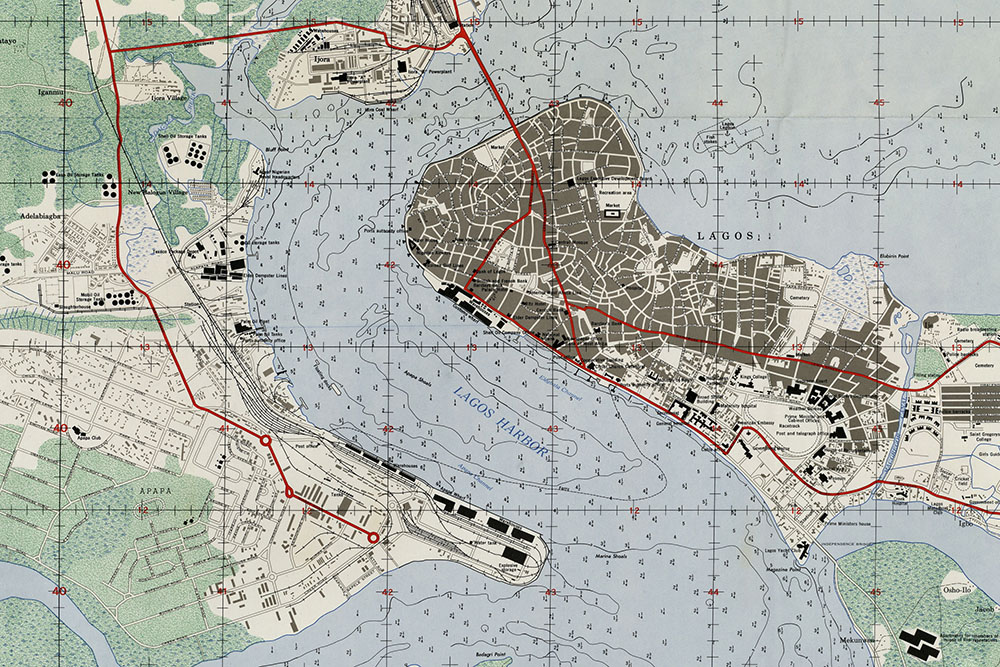

Under British colonial rule, Lagos developed into West Africa’s leading harbour. Engineering works at Apapa in the early twentieth century created deep‑water quays that made it the main maritime gateway of Nigeria.
In the First World War, the port served as a staging ground for the Allied campaign in Kamerun, supplying troops and materiel while the Nigerian Marine provided coastal patrols. Though never attacked, Lagos was vital to Allied logistics in the Gulf of Guinea.
By the Second World War, Lagos had become the busiest port in the region. Apapa’s expanded facilities supported convoy assembly, naval patrols, and the embarkation of Nigerian regiments bound for East Africa, North Africa, and Burma. The harbour gained particular prominence in January 1942, when captured Axis ships from Operation Postmaster were brought in under Royal Navy guard, underscoring Lagos’s role as a secure Allied base.
By 1945, Lagos had firmly established itself as the strategic hub of British West Africa, a position it retained as Nigeria’s principal port in the postwar era.
Operation Postmaster
The Maid Honor, a converted Brixham trawler operated by the Special Operations Executive (SOE), departed Dartmouth on August 12, 1941, bound for equatorial West Africa. Her mission was to conduct covert operations against German U-boats and Axis ships in the region, culminating in the daring raid known as Operation Postmaster, which took place in January 1942 in the harbor of Santa Isabel on the Spanish island of Fernando Po (now Bioko, part of Equatorial Guinea). She reached Lagos on December 14, 1941.
The port was used to launch the mission against the two vessels (one German and another Italian) in Santa Isabel.
Do you have more information about this location? Inform us!
Source


Looking for reliable information or news facts about WW2? Do you want to create your own battlefield tour to sights of wars from the past? Or are you interested in war medals and their recipients? TracesOfWar.com tells you more!
More information

© STIWOT, 1999-2025. All rights reserved. Privacy statement, cookies, disclaimer and copyright